Joel Burden
Context of Practice
Showing posts with label OUGD501 - Lectures. Show all posts
Showing posts with label OUGD501 - Lectures. Show all posts
Identity.
To introduce historical conceptions of identity. To introduce Foucault's 'discourse' methodology.
Essentialism (traditional approach to identity). Our biological make up makes us who we are. We all have an inner essence that makes us who we are.
Phrenology - idea that there is a perfect ratio of characteristics to a well balanced person.
Positivist Criminology - the notion that criminal tendencies are inherited.
Physiognomy - intelligence judged by look and gradient of facial features. Legitimising racism, pointed out anglo-teutonic(northern european) are more intelligent and racially superior than negro's of mixed race.
Hieronymous Bosch (1450 - 1516) Christ carrying the cross. Shows sub-human figures.
Pre modern identity, 'secure' identities.
Farm-worker, the soldier, the factory worker, the housewife, the gentleman, husband-wife (family).
Baudelaire - introduces concept of the 'flaneur' (gentleman-stroller). Upper class, don't need to work, have time to stroll around and take in the city.
Veblen - 'Conspicuous consumption of valuable goods is a means of reputability to the gentleman of leisure'. Introduction of the 'Leisure-class'.
Upper classes wear expensive clothes to show their wealth. Lower classed copy this so upper classes look for something new to wear to keep their sense of identity.
'Discoure analysis'. Possible discourses to describe how someone gains an identity. Age, class, gender nationality, race, gender and sexuality.
To be aware of class you normally need to be aware of your own class identity.
Humphrey Spender, Worktown project, 1937. Loaded view on northern working class by southern upper.
Post Modern theory.
Identity is constructed through our social experience. Zygmunt Bauman, writes many books about identity. Identity (2004), Liquid Modernity ()
Creative Rhetorics.
Clarify how creativity is talked about...
The Blank Sheet Project - D&AD. Illustrates what creatives feel creativity means.
Felt he danced through the movie 'blade runner' as an actor. He clicked with the director and the story and everything fell into place.
Believes his greatest project will always be the next one. Also tells us to "be stupid", think with the heart not with the head. Any new idea will be seen as stupid in the beginning by the smart people until it becomes the norm.
Mimesis - plato's (427BC - 346BC) problem with creativity. The idea the physical world mimics a real world beyond, therefore art itself imitates an imitation.
The romans believed that greek art was the pinnacle of art and most roman art aims to imitate this.
Creativity has been classed into 9 'rhetorics'.
1) Romantic Genius.
Originates from the 18 century. Redefined artists from craftsman to genius through romanticism. Made artists creators, not imitators. That the artist should stand aside from rules, he/she defines them. Romanticism empowered the artist.
9) The Creative Classroom.
First academics in Italy 14 century. Britain gained first art schools in the 19 century.
Celebrity Culture.
Any medium can be viewed as a vehicle for creating a celebrity culture. The famous religious books of the world's faiths are replete with examples of individuals who are well known by the general public. Some of the pharaohs of ancient Egypt set in motion devices to ensure their own fame for centuries to come. Celebrity culture, once restricted to royalty and biblical/mythical figures, has pervaded many sectors of society including business, publishing, and even academia (the scilebrities). With every scientific advance names have become attached to discoveries. Especially for large contributions to humanity, the contributor is usually regarded honourably. Mass media has increased the exposure and power of celebrity. A trend has developed that celebrity carries with it increasingly more social capitalthan in earlier times. Each nation or cultural community (linguistic, ethnic, religious) has its own independent celebrity system, but this is becoming less the case due to globalization.

The Artist (2011): Good example of silent movie era and the real beginnings of celebrity culture.
Josephine Baker:
Josephine Baker sashayed onto a Paris stage during the 1920s with a comic, yet sensual appeal that took Europe by storm. Famous for barely-there dresses and no-holds-barred dance routines, her exotic beauty generated nicknames "Black Venus," "Black Pearl" and "Creole Goddess." Admirers bestowed a plethora of gifts, including diamonds and cars, and she received approximately 1,500 marriage proposals. She maintained energetic performances and a celebrity status for 50 years until her death in 1975. Unfortunately, racism prevented her talents from being wholly accepted in the United States until 1973.
Marilyn Monroe(born Norma Jeane Mortenson; June 1, 1926 – August 5, 1962) was an American actress, model, and singer, who became a major sex symbol, starring in a number of commercially successful motion pictures during the 1950s and early 1960s.
Andy Warhol begins to comment on this celebrity culture in his work, using Marilyn's face repeated almost as though it is a mask, to be repeated.
Warhol famous for saying everyone will receive '15 minutes of fame'.
Celebrities become 'brands':
Celebrities are used to sell. There lives become public, shared by society. Role-models and gossip machines to escape from our own mundane lifestyles. Living through them. Artists have explored this idea since the beginning of celebrity.
Lecture aims:
- History of Celebrity
- The relationship between photography/film/TV and celebrity
- The cultural significance of celebrities
- How contemporary identity and celebrity are intertwined
- Contemporary icons
Julia Marie Cameron:
Julia Margaret Cameron (11 June 1815 – 26 January 1879) was a British photographer. She became known for her portraits of celebrities of the time, and for photographs with Arthurian and other legendary themes.
Cameron's photographic career was short, spanning eleven years of her life (1864–1875). She took up photography at the relatively late age of 48, when she was given a camera as a present.[1] Although her style was not widely appreciated in her own day, her work has had an impact on modern photographers, especially her closely cropped portraits.
The Artist (2011): Good example of silent movie era and the real beginnings of celebrity culture.
Josephine Baker:
Josephine Baker sashayed onto a Paris stage during the 1920s with a comic, yet sensual appeal that took Europe by storm. Famous for barely-there dresses and no-holds-barred dance routines, her exotic beauty generated nicknames "Black Venus," "Black Pearl" and "Creole Goddess." Admirers bestowed a plethora of gifts, including diamonds and cars, and she received approximately 1,500 marriage proposals. She maintained energetic performances and a celebrity status for 50 years until her death in 1975. Unfortunately, racism prevented her talents from being wholly accepted in the United States until 1973.
Clark Gable - "King of Hollywood":
William Clark Gable (February 1, 1901 – November 16, 1960) was an American film actor. Though arguably best known for his role as Rhett Butler in the epicGone with the Wind (1939), which earned him his third nomination for the Academy Award for Best Actor, he was also nominated for Mutiny on the Bounty(1935), and he won for It Happened One Night (1934). His other notable films include Manhattan Melodrama (1934) and The Misfits (1961).
Starting as a stage actor, Gable appeared as an extra in silent films between 1924 and 1930, and progressed to supporting role with a few films for MGM in 1931. The next year he landed his first leading Hollywood role and became a leading man in more than 60 movies over three decades.
Gable appeared opposite some of the most popular actresses of the time. Joan Crawford, who was his favorite actress to work with, was partnered with Gable in eight films; Myrna Loy worked with him seven times, and he was paired with Jean Harlow in six productions. He also starred with Lana Turner in four features, and with Norma Shearer and Ava Gardner in three each. Gable's final film, The Misfits (1961), paired him with Marilyn Monroe (also in her last screen appearance).
Marilyn Monroe:
Andy Warhol begins to comment on this celebrity culture in his work, using Marilyn's face repeated almost as though it is a mask, to be repeated.
Warhol famous for saying everyone will receive '15 minutes of fame'.
Celebrities become 'brands':
Celebrities are used to sell. There lives become public, shared by society. Role-models and gossip machines to escape from our own mundane lifestyles. Living through them. Artists have explored this idea since the beginning of celebrity.
Critical Positions on Popular Culture.
What is the difference between high culture and low/throwaway culture?
Who sets the ideals of what is important and what is not?
'One of the two of three most complicated words in the English language.' - Raymond Williams.
What is popular culture? Popular being another term which is hard to pin down.
Certain expressions of people are dubbed as not being high culture, however all culture is purely an expression of man.
The development of heavy industry began to make clear lines of class separation between the working class and the bourgeois. Before this moment it was the idea that there was a shared culture, in reality the only people who made this culture was the upper classes. The rich who had time to create work due to the lack of need to work in menial labour to make money.
Matthew Arnold (1867) was one of the first to write about 'culture' as a backlash of the working class beginning to blur the lines. He spoke of culture being nothing to do with politics or money, basically anything with an agenda has anything to do with culture. Popular culture was a wrong way to go and we should get back to philosophy, art, literature, ballet and the opera, more to the point the things the ruling classes felt was culture.
Leavisism - F.R Leavis & Q.D Leavis. First elitist to really speak about 'Popular' culture. He spoke about the decay of society due to the popular culture. 'Culture has always been in minority keeping', this basically tells us he believes that only a minority of elitists who 'know' what culture is should set the rules. Leavis thought popular culture is just a form of escapism, of zoning out.
The Frankfurt School was a collective of philosophers were equally as critical on popular culture but from the opposite view point. They believed popular culture maintained social balance. All mass culture is identical, like a factory churning out products. All movies are basically the same with slight changes, the same for music, radio and television.
Adorno - "On Popular Music'. Found popular music bleak and promoted passives in the masses.
Subculture.
Definition:
A cultural group within a larger culture, often having beliefs or interests at variance with those of the
larger culture.
This lecture will look at in particular:


I could personally class myself as a part of the skateboard sub-culture as being a part of it for over 7 years, from my teens to adulthood. It really is a way of life, the majority of my friends I met through skateboarding, and like most subcultures is generally misunderstood by the larger society it lives within.
Parkour/free-running:
A cultural group within a larger culture, often having beliefs or interests at variance with those of the
larger culture.
 |
| Steampunk |
Skateboarding/
parkour and
free running/ graffiti as a performance of the city.
The
portrayal of youth subculture in film and photography.
The
Riot Grrrl
movement as a feminine and feminist subculture.
Skateboarding:
Skateboarding was popularized by the 1986 skateboarding cult classic Thrashin'. Directed by David Winters and starring Josh Brolin, it features appearances from many famous skaters such as Tony Alva, Tony Hawk, Christian Hosoi and Steve Caballero. Thrashin' also had a direct impact on Lords of Dogtown, asCatherine Hardwicke, who directed Lords of Dogtown, was hired by Winters to work on Thrashin' as a production designer where she met, worked with and befriended many famous skaters including the real Tony Alva, Tony Hawk, Christian Hosoi and Steve Caballero.
Skateboarding was, at first, tied to the culture of surfing. As skateboarding spread across the United States to places unfamiliar with surfing or surfing culture, it developed an image of its own. For example, the classic film short Video Days (1991) portrayed skateboarders as reckless rebels.
The image of the skateboarder as a rebellious, non-conforming youth has faded in recent years. Certain cities still oppose the building of skateparks in their neighborhoods, for fear of increased crime and drugs in the area. The rift between the old image of skateboarding and a newer one is quite visible: magazines such as Thrasher portray skateboarding as dirty, rebellious, and still firmly tied to punk, while other publications, Transworld Skateboarding as an example, paint a more diverse and controlled picture of skateboarding. Furthermore, as more professional skaters use hip hop, reggae, or hard rock music accompaniment in their videos, many urban youths, hip-hop fans, reggae fans, and hard rock fans are also drawn to skateboarding, further diluting the sport's punk image.

Lords of Dogtown:

I could personally class myself as a part of the skateboard sub-culture as being a part of it for over 7 years, from my teens to adulthood. It really is a way of life, the majority of my friends I met through skateboarding, and like most subcultures is generally misunderstood by the larger society it lives within.
Parkour/free-running:
Cities and Film.
Looking at:
- The city in Modernism.
- The city as a public and private space.
- The possibility of an urban sociology.
- The city in Postmodernism.
- The relation of the individual in the crowd.
Georg Simmel (1858 - 1918)
German Sociologist, wrote about the effect of the city on an individual. The first to start really thinking and writing about this relationship. The resistance of the individual being swallowed by the urban. How people react and deal with these changes.
Lewis Hine (1932) photographed images of the scale of an individual compared to the scale of the city. Also looks at the relationship between the body and a city.
Buildings began to guide the way people moved through spaces. Skyscrapers represent the upwardly mobile city of business opportunity.
Manhatta (1921) Paul Strand and Charles Scheeler. <insert video clip>
Charles Scheeler, photographer who looked at the industrial and steel forms within the city.
Fordism: mechanised labour relation. Coined by Anotonio Gramsci "Americanism and Fordism". How people are working in factories and almost becoming one with the machines they work with. People worked in the factories in order to afford something they made at work such as Ford automobiles.
Modern Times (1936) Charlie Chaplin. <insert clip>
Factories close because of the stock market crash in 1929. Leading to high levels of unemployment and 'the great depression'.
Man with a Movie Camera (1929) <insert clip>
Flaneur - The term flaneur comes from the french masculine noun flaneur. Lounger, stroller. Generally was upper class in order to have the time to stroll and lounge. Another spin on this term was "a person who walks the city in order to experience it". An urban observer, someone who takes in the city and their surroundings.
Venice - City as a labyrinth of streets and alleyways in which you can get lost but will always end up back where you began. Don't look now (1973) <insert clip>
Modern examples - L.A. Noire, Metropolis, Blade Runner.
The Gaze & the Media.
Lecture 2 - The Gaze & the Media.
'according to usage and conventions which are at last being questioned but have by no means been overcome - men act and women appear. Men look at women. Women watch themselves being looked at.' - (John Berger)
Hans Memling 'Vanity' (1485).
Shows a women looking at her distorted reflection, we see in the mirror what she would see, not from our perspective. We are led to think she is primarily interested in looking upon her own reflection.
Alexandre Cabanel ' Birth of Venus' (1863).
We see how she covers her own face with her hand. This is seen often in contemporary photography and advertising. It looks like a focus on the body instead of her face as a character.
Sophie Dahl for Opium, `Photography.
Sexual references, hand touching breast, legs open. Originally landscape but deemed too indecent, was turned portrait which gave a greater focus on the face and was then deemed acceptable, though it is fundamentally the same image.
Titian's Venus of Urbino, (1538).
Passive nude. Berger compared it to MANET 'Olypia'. The hand over by it's position looks casual in one and defensive in the other. Feels voyeur, relaxed.
MANET - 'Olympia' (1863).
Defensive, looks wealthy due to the cloth and slave giving flowers. The tilt of her head looks as though she is addressing us.
Ingres 'Le Grand Odalisque' was used by the Guerilla Girls as a feminist rights protest campaign within the art world.
MANET - Bar at the Folies Bergeres, 1882.
We can see her from two positions, one as ourselves and one as the character who can be seen talking to her reflection. A comment on social perception.
Jeff Wall 'Picture for Women' (1979).
Doubling of the gaze, we are reminded of the gaze of the camera and the gaze of the figures. Instead of feeling like an invisible spectator, you are being looked upon as you are looking upon them.
Coward, R. (1984).
The camera in contemporary media has been put to use as an extension of the male gaze at women on the streets.
Eva Herzigove, 1994.
Wonderbra billboard advert. 'Hello Boys'.
Coward, R.
The profusion of images which characterises contemporary society could be seen as an obsessive distancing of women... a form of voyeurism. Peeping Tom, 1960.
Dolce & Gabbana, 2007.
Male bodies are reflected as a fitness way, it is not passive. They return the gaze. Feels like a celebration of the human body. Different to female bodies in advertising.
Marilyn: William Travillas dress from 'The Seven Year Itch' (1955).
Freud describes the enjoyment of looking upon another body. The cinema is a perfect environment for voyeurism. The pleasure of looking has been described as a split between an active male and a passive female.
Lara Croft: Tomb Raider.
A visual spectacle to be consumed. Overly sexualised object. Pleasure is in the fantasy of her destruction. Seen as powerful but still seen as a sexual female object.
Artemisia Gentileschi 'Judith Beheading Holofernes'. 1620.
Painting by a women showing an active role, forceful. The arms are emphasised, not the body. The gaze is challenged.
Pollock, G (1981)
Cindy Sherman, "untitled Film Still 6. 1977 - 79.
Turned image like the Opium advert. Mirror facing away so can't see any reflection. Focus on the face. Would of been perhaps sexual but has been challenged and the gaze has been altered. Awkwardness with her hand, looks strange, challenges conventions of the male gaze.
Barbara Kruger ' Your Gaze Hits the Side of my Face' (1981).
Figure turning away from the male gaze. 'Hits' is a direct attack against female objectivity.
Sarah Lucas 'Eating a Banana' 1990.
Eating a banana is a sexual reference but it feels self-conscious. The realisation of eating a banana in public could look sexual. She's almost saying 'what are you looking at'. Almost challenging the viewer.
The mail caught with fake story of the Amanda Knox trial.
Social networking is used to perpetuate the male gaze/ the gaze of the media.
Susan Sontag (1979) 'On Photography'. To photograph is to appropriate the thing photographed.
Reality Television. Appears to offer us the position as the all seeing eye. The power of the gaze. Allows us a voyeuristic passive consumption of a type of reality. Editing means that there is no reality. Contestants are aware of their representation. We are only seeing an edited version, it's not reality. It's mediated.
The Truman Show (1988) Peter Weir. Look at this reality concept.
Big Brother 2001. Gives us the female and male body to focus on. Voyeurism has become everyday and saturated. They are aware they are being viewed, not truly voyeur.
<look at further reading and do independent research>
Panopticism. Institutions and Institutional Power.
Social Control. How society affects the way we behave and our actions. Pre-determined by society.
Institutions in terms of groups or things which have organised practices. Artists and designers work within these institutions, this tells them ultimately what's good and what's bad and directs their practice.
Aims:
Michel Foucault
Institutions in terms of groups or things which have organised practices. Artists and designers work within these institutions, this tells them ultimately what's good and what's bad and directs their practice.
Aims:
- Understand the principles of Panopticon.
- Understand Michel Foucault's concept of 'disciplinary society'.
Michel Foucault
(1926 - 1984)
Madness & Civilisation.
Discipline & Punish: The Birth of the Prison.
The Great Confinement (late 1600's). Madness was looked upon differently. More like a village idiot mentality.
Anyone who was seen as lacking in social productivity was put into 'Houses of Correction' to curb unemployment and idleness. This included, madmen, criminals, single mothers etc. Anyone who was seen to not be useful to the overall institution. They were forced to work through physical punishment.
In the 18th century these houses of correction had begun to look unsavoury, they were starting to seem like a mistake. This gave birth to specialist institutions to house these people such as prisons for the criminals and asylum's for the mentally challenged.
In the asylum's they were almost treated like children, being rewarded for good behaviour and punished for the other. Foucault states this as the beginning of modern practices such as psychiatry. He begins to see how these institutions have started to alter people's consciousness.
Punishment was used by the state as a statement of power over it's people. Public disciplines showed the people the consequences of not obeying them. Such as the Guillotine in France.
Foucault was interested in how this spawned the modern 'disciplinary society'. "Discipline is a 'technology'". He calls this study Panopticism named after a building called the Panopticon proposed by Jeremy Bentham in 1791. It was designed as a multi-functional building, meaning it could be a list of things including prison's and asylums. What was special about this was the mental affect it would have on it's inhabitants. Each cell faced inwards towards the centre of the cylindrical building where lied an observational tower holding the prison guards. This is really all they can see, their supervisors, not the other inmates across the way. This meant constant supervision, meaning any bad behaviour would instantly be spotted, trying to project a mentality of good behaviour because there almost seems no point in acting in any other way. The Panopticon internalises in the individual the conscious state that he is always being watched.
Was claimed to be able to reform prisoners, treat patients, instruct schoolchildren, confine but also study the insane, helps supervise workers, helps put beggars and idlers to work.
Foucault says the Panopticon is a model of how modern society organises its knowledge, it's power, it's surveillance of bodies and it's 'training' of bodies.
Modern examples;
The open plan office, a modern panopticon. The workers can always be seen. Changing their behaviour knowing they are being watched, being put under scrutiny.
Open plan bar's, everyone is visible, mainly to the bouncers and the staff. This changes the way you may behave.
CCTV cameras record most places, which affects the way you behave.
Pentonville Prison was a correctional school. Each pupil was in a space divided with barriers from the pupils sat immediately next to them, all they could see was the lecturer at the front.
It's a form of mental discipline, all educational facilities employ these methods whether they are aware of it or not.
Panopticism as a mental mechanism has a physical affect on our bodies. Disciplinary Society creates what Foucault calls 'docile bodies' which are self-correcting and obedient. Without anyone forcing you, you begin to feel guilty if you don't meet this social expectations such as eating healthier and not eating your 5 a day.
Foucault and Power:
His definition is not a top-down model as with Marxism.
Power is not a thing or a capacity people have - it is a relation between different individuals and groups, and only exists when it is being exercised.
The capacity of power relies on there being the capacity for power to be resisted.
'Where there is no power there is no resistance'.
Psychoanalysis.
Lecture 1 - Psychoanalysis
1 - The development of the psyche from birth.
Psyche - The human faculty for thought, judgement and emotion; the mental life, including both conscious and unconscious processes; the mind in it's totality, as distinguished from the body.
2 - The development of our unconscious in everyday life.
3 - The development of gender identity (psycho-sexual identity).
4 - Understanding the complexities of human subjectivity.
A way of catergorising and understanding desire, motivation, dreams.
The theory and practice of psychoanalysis was first conceived by Sigmund Freud (1856 - 1939).
http://www.bbc.co.uk/history/historic_figures/freud_sigmund.shtml
Considered the father of Psychiatry, Freud devoted his life to the exploration of the human psyche. He began using this knowledge to heal hysteria sufferers, applying hypnosis treatment in order for them to accept repressed memories and thoughts. A large portion of his life he devoted to study on his own psyche, especially that of dreams, leading to his first major published work 'The Interpretation of Dreams' in 1900.
Established the psychoanalytic theory that allowed for an 'dynamic unconscious' part of the mind.
Freud's discovery of the dynamic unconscious is arguably his most important contribution to our understanding of the human mind, studying in detail both its content and alien mode of thinking. Dreams, neurotic symptoms, slips of the tongue and enigmatic thoughts burst upon us unbidden and uncontrollable. Immensely creative yet powerfully destructive, the unconscious can be a source of guidance as well as subversion, evoking both awe and dread.

Freud was also interested in something he called psycho'sexual' identity. He believed children feel what is known as the oedipus complex. The oedipus complex is a desire for sexual involvement with the parent of the same sex, whilst having a rivalry and possibly a desire to kill/hurt the parent of the same sex. Freud believed this complex is essential to a healthy development.
Females go through what is known as 'penis envy'. This stage in a female development is where the girl realises she does not have a penis. This is seen as a vital process in the sexual identity of females. Boys on the other hand get 'castration anxiety' once they realise girls do not have a penis. This again is essential to a boys development and basically consists of a fear for males of losing the penis. This relationship sees the penis or to be more specific the male being a symbol of power. Only once these have been overcome will a child have gained his/her sexual identity within society, however these feelings of gender misconceptions may continue throughout our lives.
The Uncanny - Something that simultaneously unnatural but familiar. Where the boundaries of reality and fantasy break down. Analogies between the unconscious (psychology) and the uncanny (aesthetics).
Freud Models:

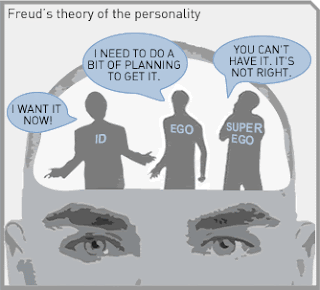
ID - Part of the unconscious, instinctual and biological elements of us.
Ego - Part of the conscious, our personality and individuality.
Super Ego - Our awareness and place in terms of others.
Jacques Lacan (1901 - 81):

1 - The development of the psyche from birth.
Psyche - The human faculty for thought, judgement and emotion; the mental life, including both conscious and unconscious processes; the mind in it's totality, as distinguished from the body.
2 - The development of our unconscious in everyday life.
3 - The development of gender identity (psycho-sexual identity).
4 - Understanding the complexities of human subjectivity.
A way of catergorising and understanding desire, motivation, dreams.
The theory and practice of psychoanalysis was first conceived by Sigmund Freud (1856 - 1939).
http://www.bbc.co.uk/history/historic_figures/freud_sigmund.shtml
Considered the father of Psychiatry, Freud devoted his life to the exploration of the human psyche. He began using this knowledge to heal hysteria sufferers, applying hypnosis treatment in order for them to accept repressed memories and thoughts. A large portion of his life he devoted to study on his own psyche, especially that of dreams, leading to his first major published work 'The Interpretation of Dreams' in 1900.
Established the psychoanalytic theory that allowed for an 'dynamic unconscious' part of the mind.
Freud's discovery of the dynamic unconscious is arguably his most important contribution to our understanding of the human mind, studying in detail both its content and alien mode of thinking. Dreams, neurotic symptoms, slips of the tongue and enigmatic thoughts burst upon us unbidden and uncontrollable. Immensely creative yet powerfully destructive, the unconscious can be a source of guidance as well as subversion, evoking both awe and dread.
Freudian slip - A verbal or memory mistake which is believed to be linked to the unconscious mind. Common examples include an individual calling his or her's spouse by an ex's name, saying the wrong word or even misinterpreting a written or spoken word.

Freud was also interested in something he called psycho'sexual' identity. He believed children feel what is known as the oedipus complex. The oedipus complex is a desire for sexual involvement with the parent of the same sex, whilst having a rivalry and possibly a desire to kill/hurt the parent of the same sex. Freud believed this complex is essential to a healthy development.
Females go through what is known as 'penis envy'. This stage in a female development is where the girl realises she does not have a penis. This is seen as a vital process in the sexual identity of females. Boys on the other hand get 'castration anxiety' once they realise girls do not have a penis. This again is essential to a boys development and basically consists of a fear for males of losing the penis. This relationship sees the penis or to be more specific the male being a symbol of power. Only once these have been overcome will a child have gained his/her sexual identity within society, however these feelings of gender misconceptions may continue throughout our lives.
The Uncanny - Something that simultaneously unnatural but familiar. Where the boundaries of reality and fantasy break down. Analogies between the unconscious (psychology) and the uncanny (aesthetics).
Freud Models:

Unconscious - Hidden, repressed. Where things are stored which are unacceptable to our conscious selves.
Preconscious - Where memories are stored and information we can recall.
Conscious - Our outward selves and personality.

ID - Part of the unconscious, instinctual and biological elements of us.
Ego - Part of the conscious, our personality and individuality.
Super Ego - Our awareness and place in terms of others.
Jacques Lacan (1901 - 81):

A French psychoanalyst who is considered one of the most controversial since Freud. He was himself a self-proclaimed Freudian and had great influence over French intellectuals throughout the 1960's and 70's.
He believed in another stage during a childs development called 'The Mirror Stage'. The recognition of a childs own reflection which leads to the child being able to see themselves as an object which can be viewed by the child from outside themselves. He also believed the unconscious was structured like a language
Subscribe to:
Posts (Atom)
Copyright 2010. All rights reserved.
RSS Feed. This blog is proudly powered by Blogger and uses Modern Clix, a theme by Rodrigo Galindez. Modern Clix blogger template by Introblogger.